Jacket Collar Types Explained: Stand-Up, Camp, Shirt Collar Guide
What are the main jacket collar types and how do they differ? There are three primary categories. Stand-up collars sit upright around the neck and never fold down, including styles such as band, Mandarin, and funnel collars. Camp collars lie flat and open at the chest, creating a relaxed, off-duty look. Shirt-style collars combine a standing base with a folded turnover, following the same construction principles as a dress shirt but adapted for leather, denim, or wool jackets. The best choice depends on your neck length, personal style, and how formal or casual you want the jacket to appear - not simply how it looks on the hanger.
Two tabs open. Same brand, same price, same black leather. One jacket reads expensive. The other reads costume. Scroll down and the difference is almost never the leather grade or the stitching - it's the collar.
A collar is the only part of a jacket that sits next to your face. Everything else (the cut, the pockets, the hem) talks to your body. The collar talks to your jawline, your neck, your whole "first three seconds" impression. That’s a disproportionate amount of influence for one small piece of fabric.
It's also doing more business than people realize right now. Classic biker, bomber, and moto silhouettes saw a real revival in 2025, driven largely by Millennial and Gen Z demand - and a stand-up or shirt-style collar is usually the detail separating a genuinely well-cut biker jacket from a costume-rack knockoff. The terminology for why one collar feels structured and another feels floppy actually goes back to basic pattern-cutting categories, the same ones described in any Collar (clothing) overview: stand, flat, and roll. Three families. Every jacket collar you'll ever own belongs to one of them.
By the end of this guide, you'll be able to glance at a stand collar, a camp collar, or a shirt collar and instantly clock what it's signaling - and which one actually works on your neck.
The Three Structural Families: Stand, Flat (Camp), and Roll (Turnover)
Forget the fancy names for a second. Pattern cutters only really care about three categories.
- Stand collars rise up and encircle the neck. No fold, no flop. They stand on their own structure.
- Flat collars (camp, Cuban, Peter Pan) lie flat against the garment. Open the jacket and the collar doesn't change shape - it was never meant to stand.
- Roll or turnover collars have a stand and a fold. The collar rises slightly, then turns over and rolls back down. This is the family that produces the classic shirt collar.
Here's why this matters beyond trivia: every fancy collar name you've heard - Mandarin, Nehru, Cuban, spread, point - is just a variation inside one of these three buckets. Learn the bucket, and you can predict comfort, movement, and formality before you ever try the jacket on.
| Family | How It Behaves | Jacket Examples |
|---|---|---|
| Stand | Rises and encircles the neck without folding down | Mandarin/band jackets, funnel-neck moto pieces |
| Flat | Lies open and flat against the chest | Camp-collar summer jackets, overshirts |
| Roll / Turnover | Combines a standing base with a fold-down section | Shirt-collar bikers, denim truckers, blazers |

Stand-Up Collars: Band, Funnel, and Minimal Power
A stand-up collar does exactly what it sounds like. It rises up around your neck and stays there. No fold-down, no roll, no flop in the wind.
You'll see this family on band-collar and Mandarin-style jackets, funnel-neck moto pieces, and Nehru-adjacent designs. The collar sits close to the throat and the lines stay tight and vertical.
What that does to a jacket's read: clean. Minimal. A little futuristic. There’s no extra fabric to break up the silhouette, so the eye travels straight up the front of the jacket to your face. That’s exactly why stand collars show up so often on technical outerwear and minimalist leather - the brief is "uncluttered," and a stand collar delivers that without trying.
It also plays nicely with layering. A high stand collar won't fight a scarf or a chunky knit underneath the way a wide shirt collar will. You're not negotiating bulk at the neck.
The catch (and there's always a catch): height. A stand collar cut too high can crowd a short neck, and on the wrong proportions, it reads severe rather than sleek - more interrogation-room than minimalist-cool. Longer necks tend to carry a high stand effortlessly. Shorter necks should look for a lower stand, or skip the family entirely and head toward a roll collar instead.
If minimalist leather is the goal, this is where Jacketshive’s black leather jackets collection earns its keep - the cleaner cuts in that range lean stand-collar or close-to-the-neck, which is the whole point of choosing this family in the first place.

Camp Collars: Relaxed, Open, Resort-Ready
Camp collars (also called Cuban collars) lie flat against the garment and open into a small notch at the front. No collar stand fighting your throat. No buttoning all the way up. The whole point is openness.
The effect lands immediately. A camp collar makes a jacket read more casual the second you put it on - even before you’ve decided what to wear underneath it. It opens up the chest line, which is exactly why it’s the collar of choice for summer jackets, lightweight overshirts, and casual leather or cotton pieces that need to feel unbothered rather than buttoned-up. As Taylor Stitch's own camp collar styling notes point out, the shirt traces back to workwear roots and a notched, ventilated build - function first, vibe second.
(Yes, that's the same collar family people complain looks "too relaxed" for the office. It's supposed to.)
Here's the part most guides skip: camp collars are genuinely flattering on a wide range of face shapes because they create visual space below the jaw instead of crowding it. That's a real advantage over a tight stand collar for anyone with a fuller face or shorter neck.
But let's be straight about the limits. A camp collar is not a formal-wear move. Pair it with the wrong setting and it just looks underdressed, not relaxed. And on a genuinely long neck, a very low-cut camp collar can over-open the chest - there's not enough structure left to balance the extra length. Some structure in the fabric (a bit of weight, a touch of interfacing) keeps a camp collar from collapsing into limp pajama territory, which is the single most common failure mode of this style.

Shirt Collars on Jackets: From Biker to Blazer
The shirt collar is a stand plus a turnover that folds down - the same construction logic as a dress shirt, just translated into heavier fabric. This is the most familiar collar family on the planet, and probably the one you already own three or four jackets in without thinking about it.
You’ll see it on leather biker jackets with pointed collars, on denim and trucker jackets, and (in its more tailored cousin form) on blazer-style lapels. The fact that the leather jacket - a garment that traces back through aviator flight jackets and Schott’s original Perfecto biker design - still leans on this collar family a century later tells you something. It just works.
The effect is familiar and versatile. A shirt collar frames the face more sharply than a camp collar but reads less severe than a tall stand collar. It’s the middle ground, which is exactly why it shows up everywhere from streetwear to smart-casual.
Most neck lengths and most face shapes handle a shirt collar without much fuss - proportion matters more than your specific measurements here. Where it goes wrong: aggressive, oversized points on a small face look like they’re wearing you, not the other way around. And a tiny, dainty shirt collar on a broad-shouldered frame can look dated, almost toy-like, instead of sharp.
This is the family doing most of the heavy lifting across Jacketshive's leather motorcycle jackets collection - the pointed, structured collar on a biker jacket isn’t decoration. It’s a roll-collar pattern doing exactly what it’s built to do.

How Collar Types Change a Jacket's Personality
Same jacket cut, same color, completely different mood - that’s what swapping the collar does. Here’s the short version.
- A stand-up collar jacket reads minimalist and slightly futuristic. Clean lines, sharp focus, "head-down and moving" energy. Often moto or technical.
- A camp collar jacket reads relaxed and retro. Off-duty, warm-weather, a little vintage-coded. Approachable rather than commanding.
- A shirt collar jacket reads classic and flexible. It can nod to Americana, to biker culture, or to tailored menswear depending on what you put it over. Balanced. Adaptable. The safe bet that somehow never looks boring.
| Collar Type | Structure | Vibe / Mood | Best Use Cases |
|---|---|---|---|
| Stand-Up Collar | Upright, no fold | Clean, modern, focused | Minimalist leather, moto, technical jackets |
| Camp Collar | Flat, open notch | Relaxed, resort, retro | Summer jackets, overshirts, casual pieces |
| Shirt Collar | Stand + turnover | Classic, versatile | Bikers, truckers, blazer-style jackets |
Choosing a Collar for Your Face, Neck, and Wardrobe
Here's where theory becomes useful. A few simple rules, none of them complicated.
Long neck? You can carry a higher stand collar without it looking strange. A camp collar cut very low, though, can over-elongate - there’s nothing stopping the eye from sliding straight down. Short neck? Go lower-stand or shirt collar, and if you want camp, avoid the ones that sit too open. A high stand collar on a short neck tends to crowd it.
Narrow jawline? Softer camp collars or a moderately sized shirt collar add visual width without overwhelming. Strong, square jawline? You can take a sharper shirt collar or a more structured stand collar - angular features pair well with a bit of architecture at the neck.
For wardrobe fit: if you live in tees and jeans, a shirt-collar biker or a relaxed camp-collar cotton jacket will integrate immediately - no babysitting required. If your week mixes office and casual, lean toward shirt collars or clean stand collars in minimalist cuts; they dress up more convincingly than a camp collar ever will. If you travel constantly and need one collar type to do most of the work, shirt collars are the most forgiving of the three - easier to dress up or down than something fully relaxed.
One more thing worth saying plainly: face shape rules are guidelines, not laws. A detailed collar-and-face-shape breakdown is useful for narrowing your options, but the mirror test still beats any chart. Try the jacket on, look at the collar in profile, not just head-on, and trust what you actually see over what a guide says you should see.
And if you're still figuring out proportions more broadly - where a jacket should hit, how length interacts with your frame - that’s a different but related rabbit hole. Our jacket length guide for different body types covers it in the same easy way.

Collar Types Across Jacket Materials: Leather, Wool, Cotton
Material changes how a collar behaves, full stop. The same collar pattern in two different fabrics can look like two different garments.
Leather: Stand collars and shirt collars are the default here - leather has enough body to hold a stand collar’s shape without interfacing tricks, and the stiffness that makes leather slightly intimidating to sew is exactly what gives a shirt collar its crisp point. Camp collars do exist on leather (retro shirt-jackets, resort-leaning pieces), but they're rarer, because leather doesn’t drape the way a camp collar wants to.
Wool: Shirt-style and tailored lapel collars dominate. Stand collars show up on minimalist wool field jackets, where the brief is closer to "technical" than "classic." Wool holds a roll beautifully, which is part of why the shirt-collar family looks so at home in it.
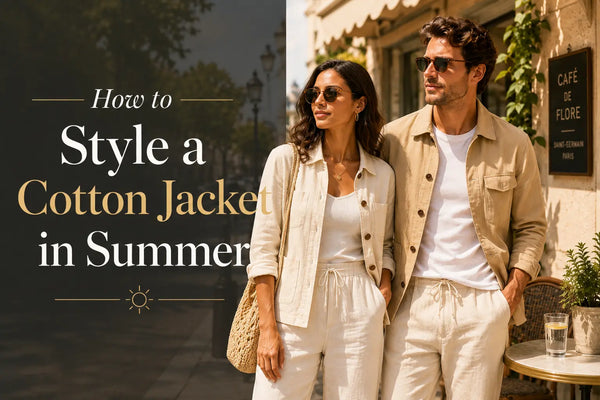
Cotton and lighter summer fabrics: This is camp collar territory, plus the occasional stand collar on utility or worker-style jackets. Cotton is light enough to flop if there's no structure at all, but breathable enough to make the open-chest camp silhouette feel deliberate rather than sloppy.
The general rule: stiffer fabric holds a sharper, more architectural collar line. Softer fabric needs either more structure built in, or a collar family (camp) that’s designed to lie flat in the first place. Mixing those up - a stiff stand collar pattern cut in soft, unstructured cotton - is a common reason a collar looks limp on arrival instead of crisp.
Construction and Comfort: What's Happening Under the Collar
This is the part nobody photographs, and it's the part that decides whether a collar actually works on a body.
Every roll or shirt collar is built around a collar stand - the inner band that shapes how the collar sits before it folds. Get the stand height and angle wrong, and the whole collar fights the neck: gaping at the back, digging in at the front, or refusing to lie the way it does in the product photo.
A well-drafted stand collar should sit close enough to read clean without choking. A well-drafted shirt collar should roll, not crease - there's a real visual difference between a soft, structured fold and a hard, awkward bend where the fabric simply gives up. Cheap construction usually shows up first at the collar, because it’s the piece under the most stress from movement, weather, and constant handling.
This is also where Jacketshive pays attention that’s easy to miss from a product photo: proportion at the collar stand is the difference between "beautiful on the hanger" and "weird on the neck." A jacket can nail the silhouette everywhere else and still get rejected at the fitting-room mirror because the collar was an afterthought.
FAQs
What is the difference between a stand-up collar and a shirt collar on a jacket?
A stand collar rises and stops there - no fold. A shirt collar has that same rise but adds a turnover that folds down, which is why it looks softer and more familiar against the face.
Is a camp collar only for summer jackets?
Mostly, but not exclusively. Heavier fabrics (suede, brushed cotton, even some wool blends) can carry a camp collar into cooler months - the open silhouette stays, the seasonal logic just shifts.
Which collar type looks best with a hoodie or scarf underneath?
Shirt collars layer the most predictably; the fold gives extra fabric room. Stand collars can fight bulky layers if cut tight, so check the stand height before pairing one with a chunky scarf.
Can I wear a stand-up collar jacket in a business casual office?
Yes, especially in neutral colors and minimal leather or wool builds. The collar reads "considered," not "casual," as long as the rest of the outfit doesn’t undercut that.
What collar type should I choose if I have a short neck?
Lower-stand collars or moderate shirt collars, generally. If you want camp, avoid versions cut very low and open - they can make a short neck look even shorter.
Do women's and men's jackets use collar types differently?
The same three families apply to both. The differences are mostly in proportion and styling - collar height and spread get scaled to fit, but stand, flat, and roll logic doesn’t change by gender.
How do I know if a collar is too big or too small for my face?
Stand in front of a mirror with the jacket buttoned as you'd actually wear it. If the collar visually competes with your jaw rather than framing it, it’s miscalibrated - too large overwhelms, too small disappears.
Once you know your collar type, browsing Jacketshive's collections stops feeling random - you can go straight to the jackets whose collars actually fit your face and your life. You know what works for you now.